The Qualities of AI-Resilient Careers
The Qualities of AI-Resilient Careers

The rapid rise of artificial intelligence is rewriting the rules of work. From generative text models
to machine-vision systems, AI can now perform tasks that once required years of human training.
This has triggered both excitement and anxiety. Some see AI as a force multiplier; others see it as
a job-eater. Both views are true in part—but not equally across all fields. Certain jobs, by their
very nature, are more resistant to automation. These are the AI-resilient careers, and
understanding their defining qualities is essential for anyone planning a secure professional
future.
1. Complex Human Interaction
One of the most defining traits of AI-resilient careers is their reliance on nuanced human
interaction. AI can process language, but it lacks lived experience, emotions, and the ability to
build authentic trust. Professions such as counseling, negotiation, and diplomacy require
empathy, emotional intelligence, and the capacity to read subtle non-verbal cues in real time.
A therapist, for example, doesn’t just ask questions and log answers. They pick up on hesitation,
body language, and the weight behind someone’s choice of words. They adjust their tone, timing,
and even silence to fit the moment. These layered interpersonal dynamics are hard for AI to
replicate because they’re grounded in human connection, not just pattern recognition.
Examples: Psychologists, social workers, conflict mediators, executive coaches, and skilled
negotiators.
2. High-Stakes Decision-Making with Accountability
AI can make predictions, but it cannot carry moral or legal responsibility for its choices. In fields
where decisions have life-and-death consequences—or major ethical implications—humans
remain the ultimate decision-makers.
Consider surgery. AI may guide a surgeon, identify anatomical structures, or suggest techniques,
but when complications arise mid-operation, it’s a human’s judgment and accountability that
matter. The same is true in law, aviation, and emergency management. These jobs often involve
incomplete information, rapidly changing conditions, and moral dimensions that cannot be
reduced to algorithms.
Examples: Surgeons, airline pilots, judges, military officers, emergency response coordinators.
3. Creative and Original Problem-Solving
AI is excellent at remixing existing patterns. It struggles when it must create truly novel solutions
outside those patterns. Fields that demand original thought—especially when the problem is
undefined—remain human-led.
For instance, designing a new product for an emerging market often means there is no historical
dataset to feed into a model. Innovators must combine intuition, experience, and insight from
disparate fields. They must spot needs before they’re articulated, navigate ambiguity, and
synthesize unexpected connections—things AI does poorly without human prompting.
Examples: Entrepreneurs, research scientists, product designers, strategic consultants, inventors.
4. Physical Dexterity in Unstructured Environments
While robots excel at repetitive tasks in controlled settings, they falter in environments that are
unpredictable, varied, or require fine-motor adaptability. Humans can improvise movements,
switch tools mid-task, and adjust instantly to changes.
A construction worker on a busy job site encounters shifting weather, uneven surfaces, and the
need to make judgment calls on safety. An electrician must navigate tight spaces and adapt wiring
plans to on-site realities. These require a blend of skill, adaptability, and sensory feedback that
AI-driven machines still struggle to match.
Examples: Skilled tradespeople, field engineers, paramedics, artisans.
5. Ethical Oversight and Value Judgment
AI has no moral compass—it can optimize for a metric but cannot decide whether that metric is
just or humane. Careers that safeguard ethics, fairness, and societal impact will remain crucial.
Policy-makers, ethicists, and compliance officers guide decisions that shape laws, corporate
practices, and community welfare. They weigh competing values, anticipate unintended
consequences, and decide where the limits of technology should be drawn. While AI can surface
risks, it takes a human to decide what level of risk is acceptable.
Examples: Ethics boards, compliance officers, human rights lawyers, policy analysts.
6. Deep Cultural and Contextual Understanding
Language models can translate words, but they often miss cultural subtleties, historical context,
and symbolic meaning. Work that requires an intricate understanding of local customs, traditions,
and shared histories is inherently human-driven.
For example, an anthropologist working with Indigenous communities must earn trust over years,
understand oral traditions, and respect spiritual practices. A marketing strategist expanding into
a foreign market must navigate cultural taboos, humor, and storytelling traditions that no dataset
fully captures.
Examples: Anthropologists, cultural advisors, brand strategists, diplomats.
7. Continuous Relationship-Building
Some careers hinge on long-term trust and reputation built over years, where personal
relationships are the foundation of success. While AI can assist with communication, it cannot
replace the bond of human familiarity.
Sales executives in complex B2B markets, for instance, do more than pitch products—they build
rapport, remember personal milestones, and read unstated concerns. Similarly, political leaders
must cultivate credibility and alliances that endure beyond single transactions.
Examples: Senior account managers, political representatives, community organizers, talent
agents.
8. Learning and Adapting in Real Time
AI models are trained on static datasets that may quickly become outdated. Humans can adapt
on the fly, applying lessons from new experiences in ways that are not pre-programmed.
In disaster relief, conditions can shift hourly. A relief coordinator must integrate fresh reports,
navigate logistical challenges, and make calls in conditions no algorithm has been trained for. This
kind of adaptive resilience keeps humans in the loop.
Examples: Disaster relief leaders, field journalists, expedition leaders, investigative detectives.
9. Integration of Multiple Disciplines
Jobs that blend expertise from multiple, unrelated fields are more resistant to automation. AI can
be specialized in one domain but often lacks the capability to merge knowledge from distinct
disciplines into a single coherent solution.
Take biomedical engineering. It demands mastery of biology, engineering, and regulatory policy,
plus collaboration with diverse experts. The role is less about running predefined procedures and
more about bridging knowledge gaps—something AI is far from mastering without human
orchestration.
Examples: Interdisciplinary researchers, systems architects, public health planners.
10. Work That Shapes AI Itself
Finally, some careers will be resilient precisely because they are involved in the creation,
oversight, and improvement of AI. These roles require domain expertise, ethical awareness, and
an understanding of both human and machine capabilities.
AI auditors, human-in-the-loop trainers, and hybrid AI project managers combine technical
literacy with sector-specific insight. They ensure AI is developed and deployed in ways that align
with human needs and legal requirements.
Examples: AI ethicists, machine learning engineers, human-centered design specialists.
Future-Proofing Through Skills
No career is entirely immune to AI’s influence. Even in resilient fields, AI will reshape workflows,
expectations, and required skills. The key is to stay ahead by developing attributes that
complement rather than compete with AI:
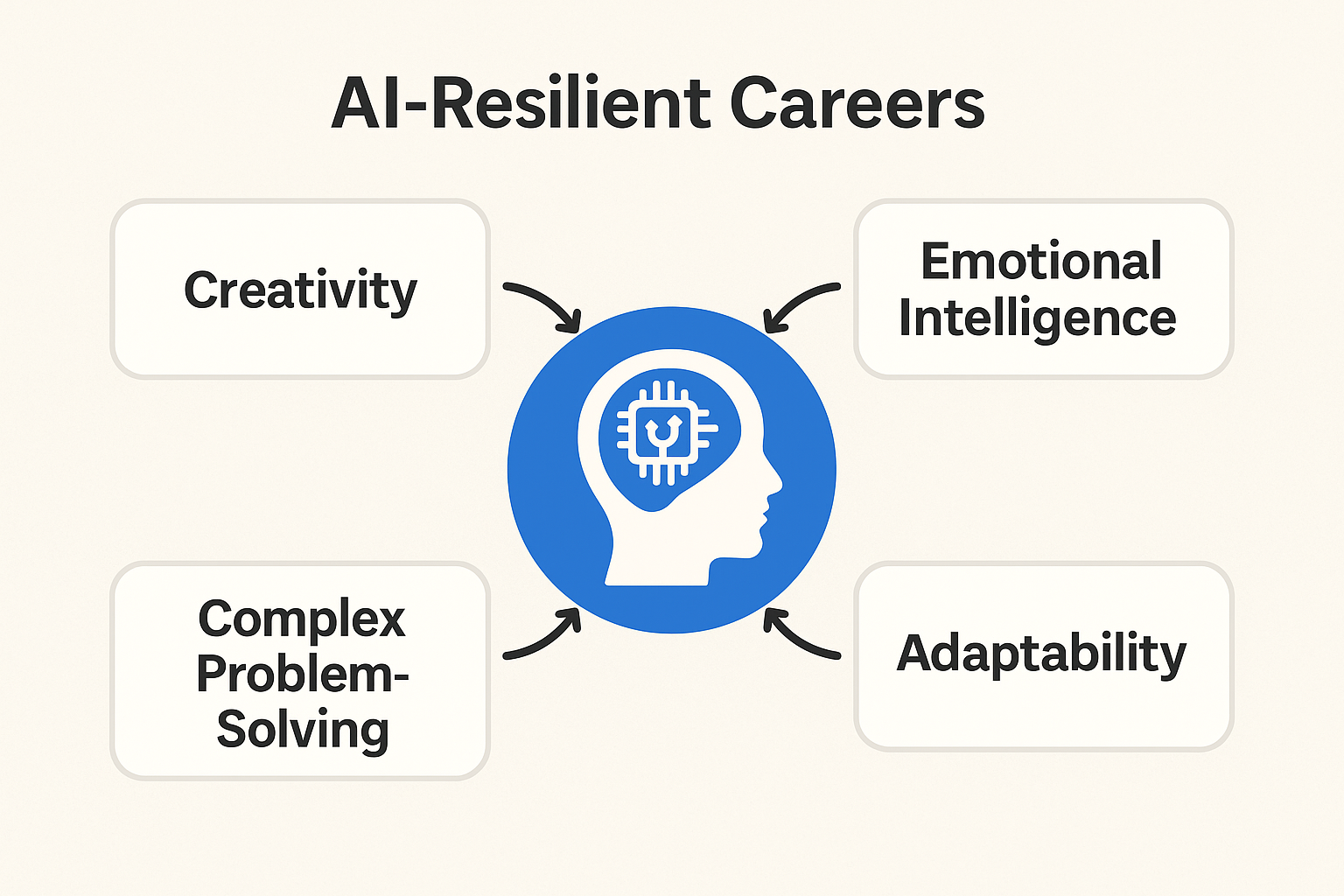
• Emotional intelligence for building trust and understanding others.
• Critical thinking for evaluating AI outputs and spotting flawed reasoning.
• Adaptability to adjust as tools and market needs evolve.
• Cross-disciplinary knowledge to create connections AI cannot see.
• Ethical reasoning to guide technology toward socially responsible outcomes.
These skills are not static—they require lifelong learning. Professionals who combine them with
domain expertise will thrive even in an AI-heavy landscape.
Conclusion
AI is not the end of human work, but it is the end of certain kinds of work. Tasks that are repetitive,
predictable, and data-driven will be automated first. The jobs that remain—AI-resilient careers—
share common traits: they are grounded in deep human connection, demand accountability for
high-stakes decisions, require creativity beyond existing patterns, depend on adaptability in
unpredictable settings and often involve shaping AI’s role in society itself.
Rather than fearing automation, workers can view these qualities as a blueprint for resilience. By
cultivating the abilities AI lacks, individuals can build careers that not only survive technological
disruption but also use it to their advantage. In this way, the rise of AI becomes not a threat, but
a catalyst for more human-centered, meaningful work.
By
Huma Zain